


The Thorlabs Raman Spectroscopy Kit is a modular spectroscopy system that features a large (2.3 mm x 3.2 mm) coded aperture at the spectrograph input instead of a traditional slit to achieve a high signal-to-noise ratio (700:1), a low power density (at the sample), and room temperature operation. A pseudo-Hadamard mask of order 64, i.e., a defined pattern of elements for intensity modulation, is used at the input to increase the total light throughput of the system while maintaining high spectral resolution. This kit is designed for 785 nm excitation and an 815 nm to 915 nm (500 cm-1 to 1800 cm-1) detection range.
Features
- Modular, Large Field-of-View Raman Spectroscopy Kit with a Coded-Aperture Input
- Designed for 785 nm Excitation and an 815 nm to 915 nm Detection Wavelength Range
- Attached CMOS Monochrome Camera for Room Temperature Measurements
- Wavelength and Amplitude Calibrated for Comparison to Spectral Data Bases
- Optional Adapter for Compatibility with 60 mm Cage System
- Spectra Recorded with the Included Thorlabs OSA Raman Software
Applications
- Quantitative Analysis of Chemical Mixtures
- Identification of Illegal or Dangerous Substances
- Quality Inspection (Pharmaceuticals, Food, etc.)
- Monitoring Chemical Processes at Production Sites
In comparison to traditional slit spectrographs, this kit averages Raman photons from a larger sampling volume, making it ideal for analyzing complex mixtures. The resulting output spectrum is a linear combination of the Raman fingerprints from the various molecules in the sampling volume, which can be identified through comparison to spectral databases.
A complete Raman spectroscopy system must include an RSB1(/M) base unit and a front end for collecting the scattered Raman signal; RSBR1(/M) and RSBC1(/M) front end are sold below. A 785 nm excitation source, as well as a PC for running the Thorlabs OSA Raman software, must be supplied by the user.
Base Units
The RSB1(/M) Base Unit, the core of Thorlabs' Raman spectroscopy system, is a volume-holographic grating imaging spectrograph that includes a coded input aperture and an attached Kiralux® monochrome CMOS camera. This unit is designed for 785 nm excitation; we recommend using the FPV785M VHG-Stabilized Laser or any source that meets the specifications on the Laser Requirements tab. For easy comparison to spectral databases, the base unit is wavelength calibrated, as well as amplitude corrected using a NIST-certified polynomial during factory calibration.
To get started instantly, this kit ships with the necessary accessories for mounting, including an aluminum base, mounting posts, and post clamps. The Thorlabs OSA Raman software, which is needed to acquire spectra, is available on the USB drive included with the base unit. For A full list of items shipped with each base unit, please see the Shipping List tab. Note that a polystyrene calibration sample should be used to accurately determine the laser wavelength; these calibration samples are shipped with each front end or are available for purchase separately below.
Note: The attached Kiralux camera should not be removed; disassembly of the RSB1 base unit will destroy the system calibration.
Reflective, Cuvette, and Custom Front Ends
This modular kit offers two front ends optimized for the collection of Raman-scattered photons from a variety of sample types. The RSB1(/M) reflective front end is designed to examine powder and solid samples, while the RSBC1(/M) cuvette front end is ideal for liquids. To build up a custom front end, the base unit is compatible with Thorlabs optomechanics through the SM1 (1.035"-40) and SM1.5 (1.535"-40) external threading on the aperture or our 60 mm cage system using the RSBA1 adapter (sold below).
Note that when paired with a user-supplied laser source, the front ends provide a free space beam. Necessary laser safety protocols will depend on the user's chosen laser source and the lab environment. Please consult your laser safety officer to ensure the safety of the setup before powering on any laser source.
Software
The Raman base unit ships with a USB stick that contains the Thorlabs OSA Raman Software, a folder with the camera calibration dataset, and a Microsoft Excel spreadsheet with macros for evaluating the excitation laser wavelength.
The Thorlabs OSA Raman Software is used to record Raman spectra, and the user-friendly software GUI allows the user to adjust the integration time of a single measurement, the analog gain, and the black level (pixel offset). The software also allows the user to easily change the axis units from wavelength to wavenumber, apply spectrum smoothing, and automatically correct the camera’s amplitude response with a NIST fluorescence standard for easy comparison to database spectra. For more information on the Raman software suite, please see the Software tab.
Spectrograph Base Unit

Size comparison of the coded aperture and a standard slit aperture. The coded aperture is a pseudo-Hadamard mask of order 64; the white and dark areas represent where light is transmitted through the mask or blocked, respectively.
- Volume-Holographic Grating Imaging Spectrograph with a 2.3 mm x 3.2 mm Coded Aperture
- Attached and Aligned Monochrome CMOS Camera with a USB 3.0 Interface (Item # CS895MU)*
- Designed for 785 nm Excitation Wavelength
- Amplitude Corrected using a NIST-Certified Polynomial (NIST SRM2241)
- Includes USB with Software and Camera Calibration Data
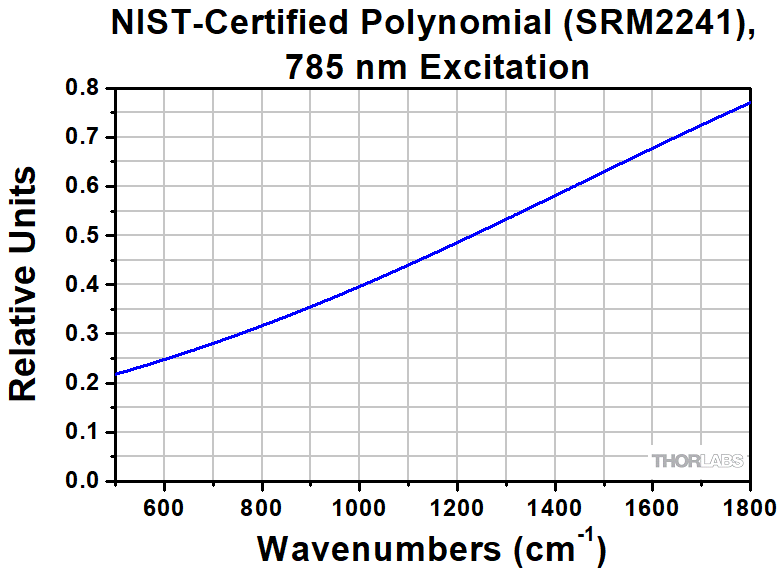
The RSB1(/M) Base Unit is the core of Thorlabs' Raman Spectroscopy Kit, which is a modular system ideal for detecting low-intensity Raman signal. Designed for a 785 nm excitation laser, spectra are recorded in the 815 nm to 915 nm wavelength range, which corresponds to 500 cm-1 to 1800 cm-1 wavenumbers. Each base unit includes an imaging spectrograph with a volume-holographic grating, a large coded-aperture (CODA) input, and an attached Kiralux Monochrome CMOS Camera; the grating and camera have wavelength-dependent efficiencies that are amplitude-corrected using a certified NIST standard during factory calibration. For optimal extraction of the Raman-scattered light, this base unit uses an internal longpass 805 nm filter.

The OSA Raman Software GUI allows for easy acquisition of Raman spectra, and it includes built-in tools for analysis. Shown here is a spectrum where peak information has been identified with the peak track tool.